 |
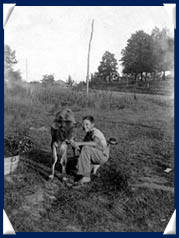
The Great Depression of the 1930's caught Harold in his younger days. He was
only six years old when it began, but as he got older, he remembers very well what it was like in those days. He said that his dad was either operating or
owned a sawmill through these years, and that is where they would grind their corn and so forth. Because of his father's job, his mother was the "farmer"
of the family. She was faithful in keeping the farm running for the benefit of the family. In the way of food, they killed their own beef and hogs, and
they also had milk cows for obtaining milk and butter.
Harold's mother also did much canning. She canned fruits and vegetables. He remembers that their storm cellar was stocked full of canned fruits on shelves
from floor to ceiling. When they had to go down in the cellar for a tornado,
the kids would always want to eat some fruit. So, in order to do this, they
would pull on the rubber seal to make the jar spew and then tell their mom that
it needed to be eaten. Of course their mother knew what they were doing, but she
always willingly let them have a jar of fruit to eat anyway.
|
Although the depression was a trying time for many people, Harold said that his family was never in need of anything. He never
had to go hungry because they always had plenty of food. And they had plenty of clothes and money as well. Back then, if you had all of those things, you were
very well off. His family even had a car. Harold also remembers chopping cotton during the Depression for thirty-five cents a day. When I was in grade
school, my sister and I chopped cotton for $3.50 an hour. How times have changed!
Harold was reminiscing of how, although they had a car, his family still walked most places. They frequently walked to church, which was a mile away. His father lived
to be ninety-seven years old, and Harold laughingly contributed this to his father's insistence to walk everywhere.
His father drove into town (Conway) only two or three times a year to buy supplies such as
flour, sugar, lard, and coffee. He bought not only for themselves but for the rest of the
family also, those members who had already married and started families of their own. Harold
stated that his father often did not get paid for the supplies he gave out, but that was just
his way of helping out because times were hard. There was a store nearby where they lived;
this is where they got supplies throughout the year. But major trips to town were few and
far between.
There were three people that Harold said had a significant impact on his life.
His mother and father and his older brother, Sam. Harold described his father
as being well respected in the community-a good man. He taught Harold how to
hunt and fish, and influenced his life a great deal. Harold described his
mother as being a "good Christian woman". He said that she always guided her
children and wanted them to do right. His parents were a good influence
on his life.
His brother Sam, who was twelve years older than Harold was of great influence
in his life. When Harold came back from World War II, he lived with Sam and his
family. Sam guided Harold, gave him advice, and was not afraid to speak up if
he thought Harold was going in the wrong direction. Sam encouraged Harold to
start working after he came back from the war and go on in life.
|
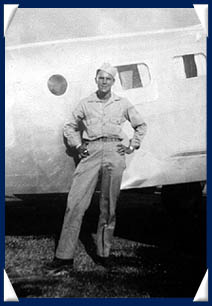
| One of Harold's major life events included his service in World War II. He
and his brother, Jack. Both served in the army. Harold's service in the war
lasted twenty-seven months. His brother had volunteered his services for the
war but told Harold to wait until he was drafted, so he did. Unfortunately,
Harold's brother was killed while serving his country, and Harold had a very
interesting story pertaining to his brother's death. While Harold and his
brother were in the war, their mother had a service flag with two stars on it.
The stars represented her two sons that were in the war. The day that she got
news of her son's death, one of the stars just peeled off. Harold still has
this flag.
Harold served in the Pacific; he went to the Philippines, Japan, and New Guinea.
He was of the first troops to enter the Philippines and liberate them. What
an experience! While there in the Philippines, they got cut off while they
were up on a hill. They were surrounded by Japanese troops, and they could
not get in or out. They also were not able to get supplies, including food.
He said that their C-47 planes would fly over and drop supplies down to them,
but they just went everywhere and the Japanese ended up getting more of the
supplies than the Americans did.
|  |
| After their rations had expired, they were
forced to live on the land for seventeen days. Harold and his troops ate
green coconuts in order to survive. They obtained their water from that
which was standing in big caribou tracks. Before drinking the water, they
would dissolve a tablet in the water to purify it. Harold said there were
times that he thought he was going to die, but he made it. As a result of
their entrapment, many of the troops, including Harold, suffered from malaria,
dysentery, and jungle rot.
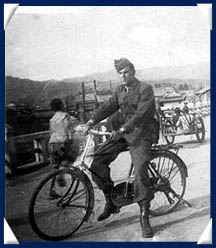
After their work in the Philippines was finished, they were prepared to go
invade Japan. However, this was when the atomic bomb was dropped, and Japan
surrendered. Thus, they went on to Japan as occupational forces, but they did
not have to go and fight.
|
 |
A special thing happened to Harold while he was away at war. He accepted the
Lord Jesus Christ as his Savior. He said that he was attending an open church
service in the jungle, and he was saved sitting on a coconut log. He heard the
sermon and was ready and willing to receive Jesus. What a blessing to know that
the Lord God saves anyone who calls on His name no matter where you are!
In January of 1946, Harold came back to the United States on the ship Phoenix
to Tacoma, Washington. He then went to Fort Smith to get his discharge. At
the time of his discharge, he was a Platoon Sergeant. Of all the trials he
faced during the war, the one thing that Harold worried about the most was his
parents dying before he got back home to them. His parents were older, and he
said that he worried about this more than getting killed himself. However, the
Lord blessed him, and he was able to see both of his parents upon his return home.
|
About a year after his return home from the war,
Harold met his wife, Ida. They met in October of 1947 at church and were married
three months later. When you know, you know! They are now going on fifty-three
years of marriage and are more in love now than ever. Harold and Ida have four
children, thirteen grandchildren, and seven great-grandchildren.
Harold reached seventy years of age; he developed lymphoma stomach cancer, which
he battled for three years. He had seventy percent of his stomach removed but is
free of the cancer today. Praise the Lord!! However shortly after his bout with
lymphoma, he developed breast cancer. He had this cancer for awhile before it was
ever diagnosed, probably because breast cancer is so rare in men. However, he just
finished his last radiation treatment TODAY and is doing great! The Lord has been
so good!
Overall, Harold feels that he has aged very successfully. He and his wife have
accomplished in life what they wanted and have had a good family life. Yet, when
asked what he would change if he could, Harold replied that he would have better
prepared for retirement. He never anticipated getting sick. He said that he had
always thought he would work 'till he died. But in summary, Harold stated, "I'm
satisfied with what the Lord has given me."
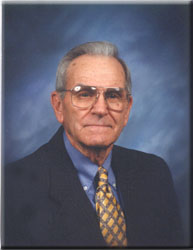
Harold Satterwhite is a wonderful, Godly man whom I feel has led a very full and
healthy life. The Lord has blessed him in so many ways, and Harold is always
thankful for that. It was a blessing to me to be able to visit with Harold and
Ida this afternoon. There is always much to learn from those who have gone
before us, and I feel that because of the conversation we had today, I am a
little wiser.
 
The above article is the property of ©Abbey Reynolds and it was placed on this
page with her permission.
Thanks so much Abbey!

The following poem
was read by my cousin, Rev. James Walter at my
Uncle Harold Dean's funeral
on Saturday November 24, 2001.
This poem truly describes the kind of person
my uncle was.
DRINKING FROM MY SAUCER
I've never made a fortune and it's probably too late now.
But I don't worry about that much, I'm happy anyhow.
And as I go along life's way, I'm reaping better than I sowed.
I'm drinking from my saucer, 'Cause my cup has overflowed.
Haven't got a lot of riches, and sometimes the going's tough.
But I've got loving ones around me, and that makes me rich enough.
I thank God for his blessings, and the mercies He's bestowed.
I'm drinking from my saucer, 'Cause my cup has overflowed.
O, Remember times when things went wrong, My faith wore somewhat thin.
But all at once the dark clouds broke, and sun peeped through again.
So Lord, help me not to gripe about the tough rows that I've hoed.
I'm drinking from my saucer, 'Cause my cup has overflowed.
If God gives me strength and courage, when the way grows steep and rough.
I'll not ask for other blessings, I'm already blessed enough.
And may I never be too busy, to help others bear their loads.
Then I'll keep drinking from my saucer, 'Cause my cup has overflowed.
~ John Paul Moore ~
|
EMAIL: janice@arkansas-roots.com
|
|
| |